
Turn climate science into pressure that your reps can't ignore

Climate Action Nuggets
for our
Members of Congress
Florida - Specific Nuggets
While these Nuggets are constructed for Florida constituent concerns, the intent is to use this template for each of the States, as well as for the greater planet. If properly constructed, both the Member of Congress (MoC) and the constituent will have learned some scientifically sound information, will have expanded their understanding of the situation they share, and will have an improved vocabulary for discussing responsive policy options.
Our nominal goals are to:
-
Identify impacts which are already obvious.
-
Put in the context of a future near enough (15 years, Gen _ will experience, my grandkids will have to endure, etc.) that a politician might emotionally identify with the concern).
-
Directly name the politician being addressed, when a specific nugget is passed on to their office.
-
Specify the ACTION requested or demanded. Particular attention will be paid to legislative initiatives in discussion in Congress. If no relevant bills are under consideration at the moment, the MoC can be called on to take the issue seriously, since the constituent does.
ADDITIONAL MATERIALS are provided in text format at the end of this resource of Nuggets. Narratives of the most pressing concerns, questions for members and office candidates, and links to essential sources are included.
(Local Concerns → Congressional Action)
FL1
Florida Is Losing Land to the Sea
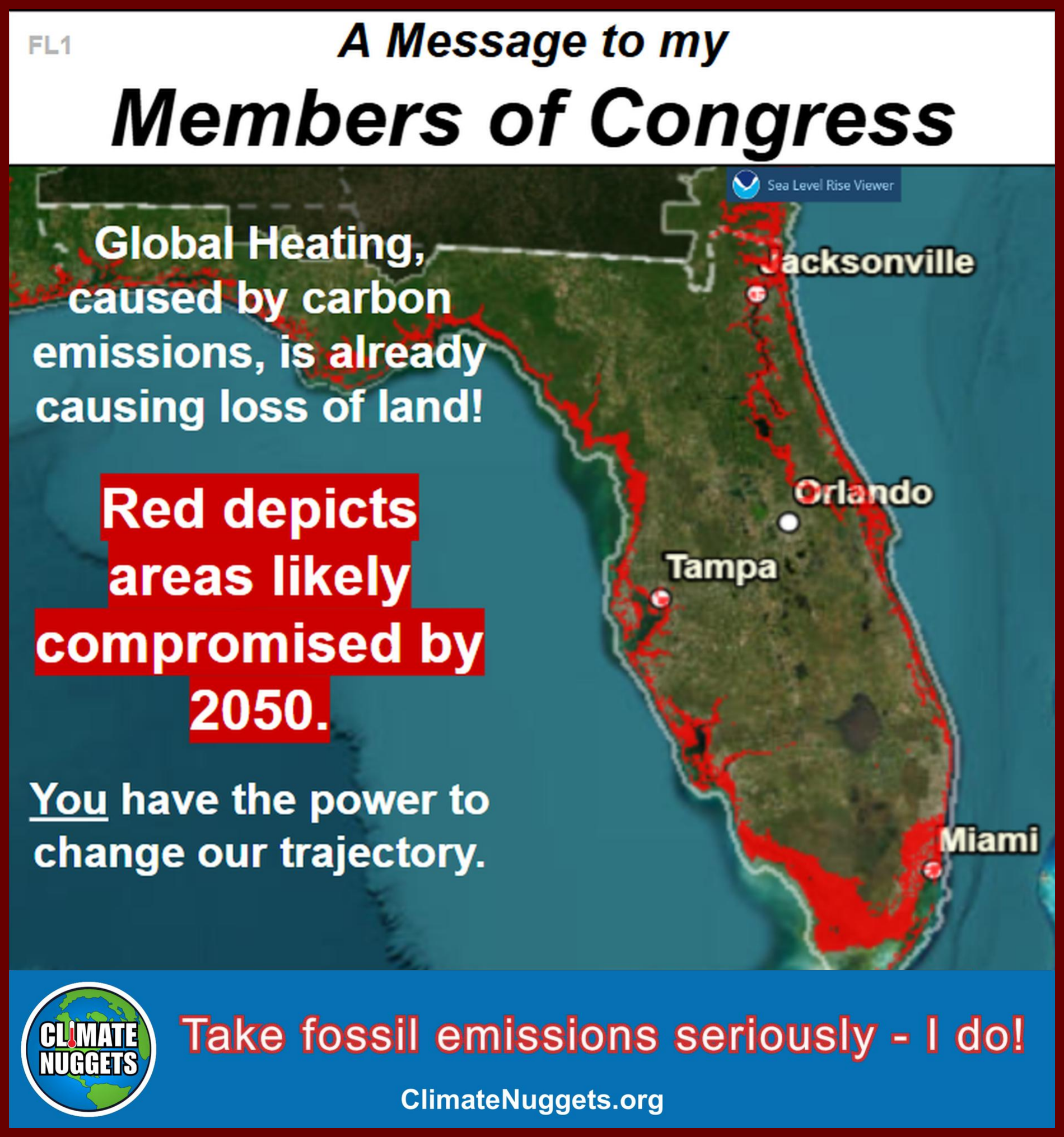
From clear-sky flooding to encroachment of salt water into fresh water sources, Florida is highly susceptible to impacts from sea level rise and storm surges. The impacted areas are steadily growing. These are results for global heating and climate change.
Heading 5
FL2
Our FL Coral Reefs Are Probably Lost
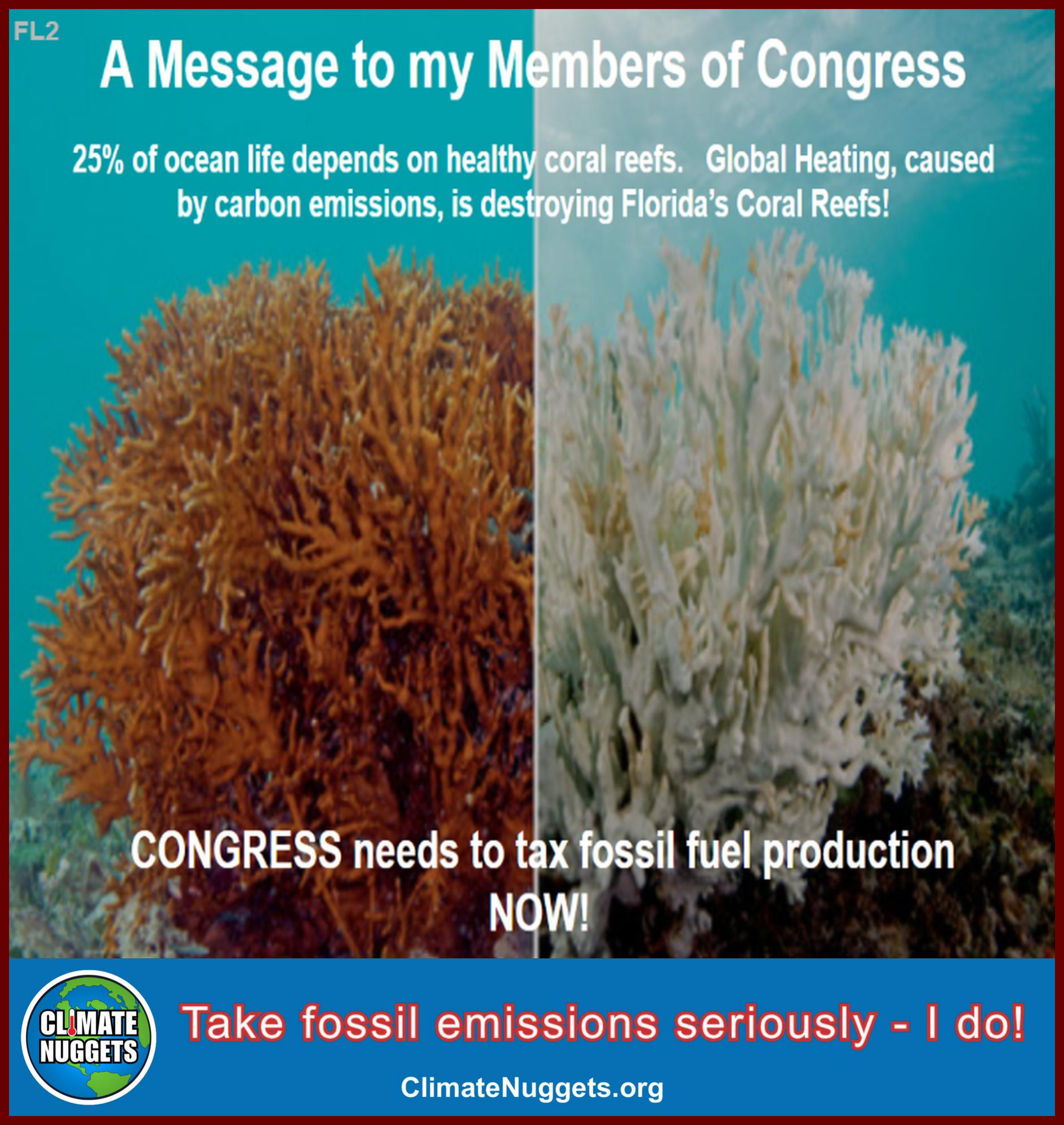
Florida is home of the third largest coral reef on the planet, and we have likely lost it irretrievably from global heating. Continued heating will ensue if we don't immediately cut fossil emissions forcing us over more tipping points.
Heading 5
FL3
FL Leads the Nation in Increased Risks to Pregnancy
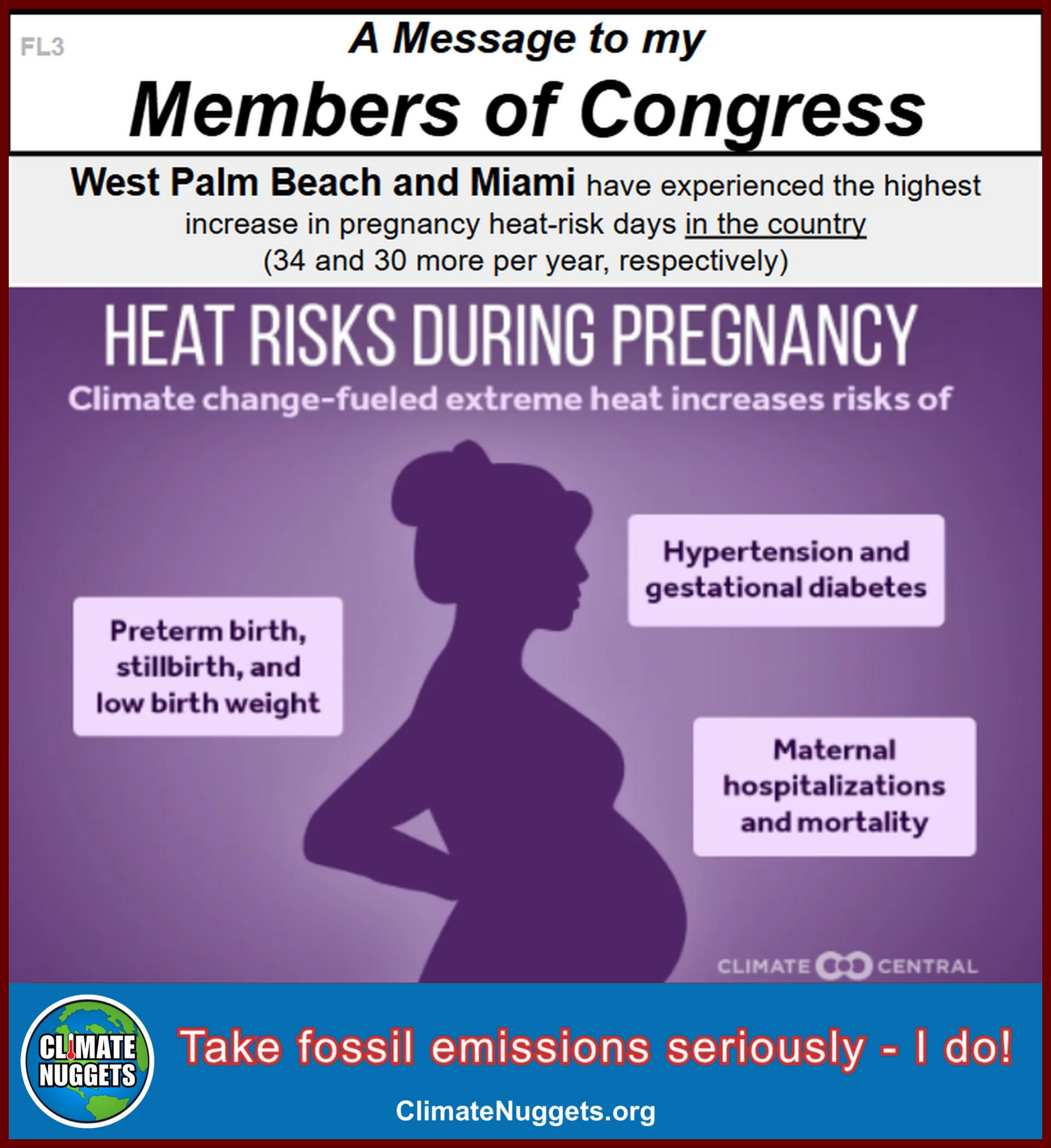
Florida cities are leading the nation in increased number of heat risk days for pregnancies. Global heating hits us all, particularly our women and children!
Heading 5
FL4
Heating Hits FL's Most Vulnerable Workers Worst
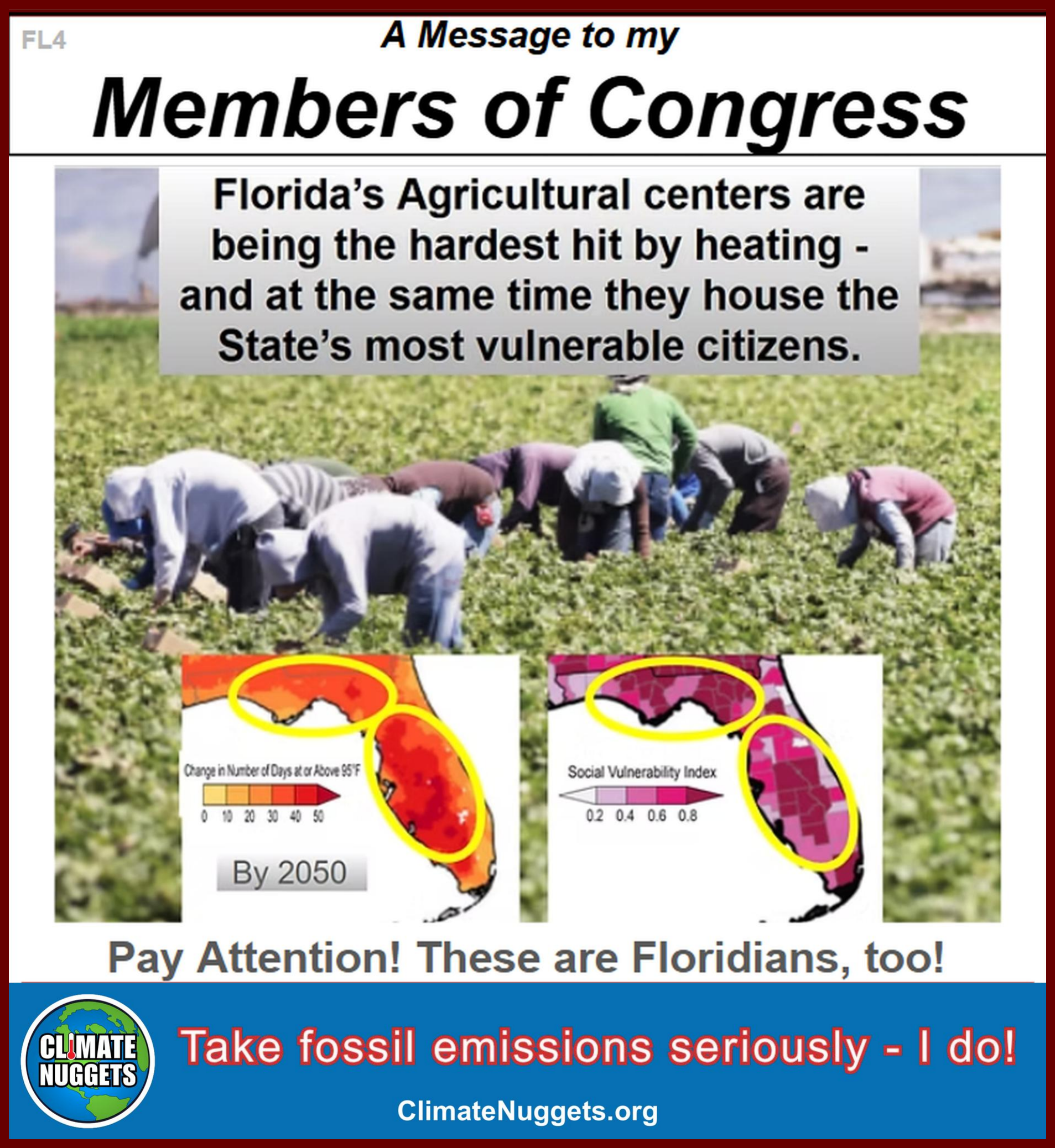
Agricultural workers are key to Florida's life and economy and are already enduring harsh and potentially deadly impact of global heating - up to 116 dangerously hot work days each growing season.
Heading 5
FL5
Clear Sky Flooding Is Drastically Increasing
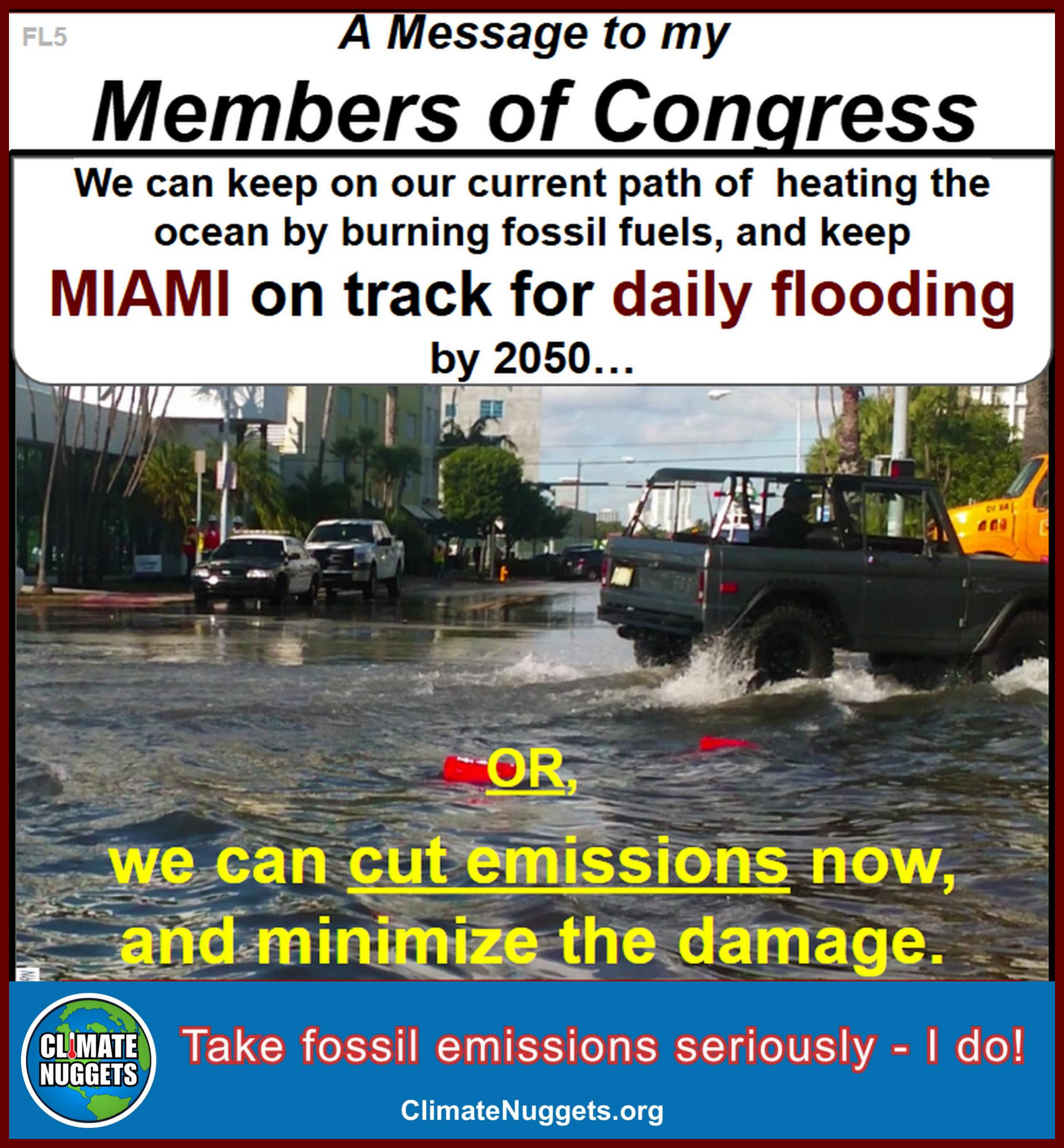
All along our Florida coast, the number of high-tide flooding days is steadily increasing. This is from global heating. It's time to understand the cause is emissions from fossil fuels and change our direction.
Heading 5
FL6
Erratic Weather Events have Increased in Florida
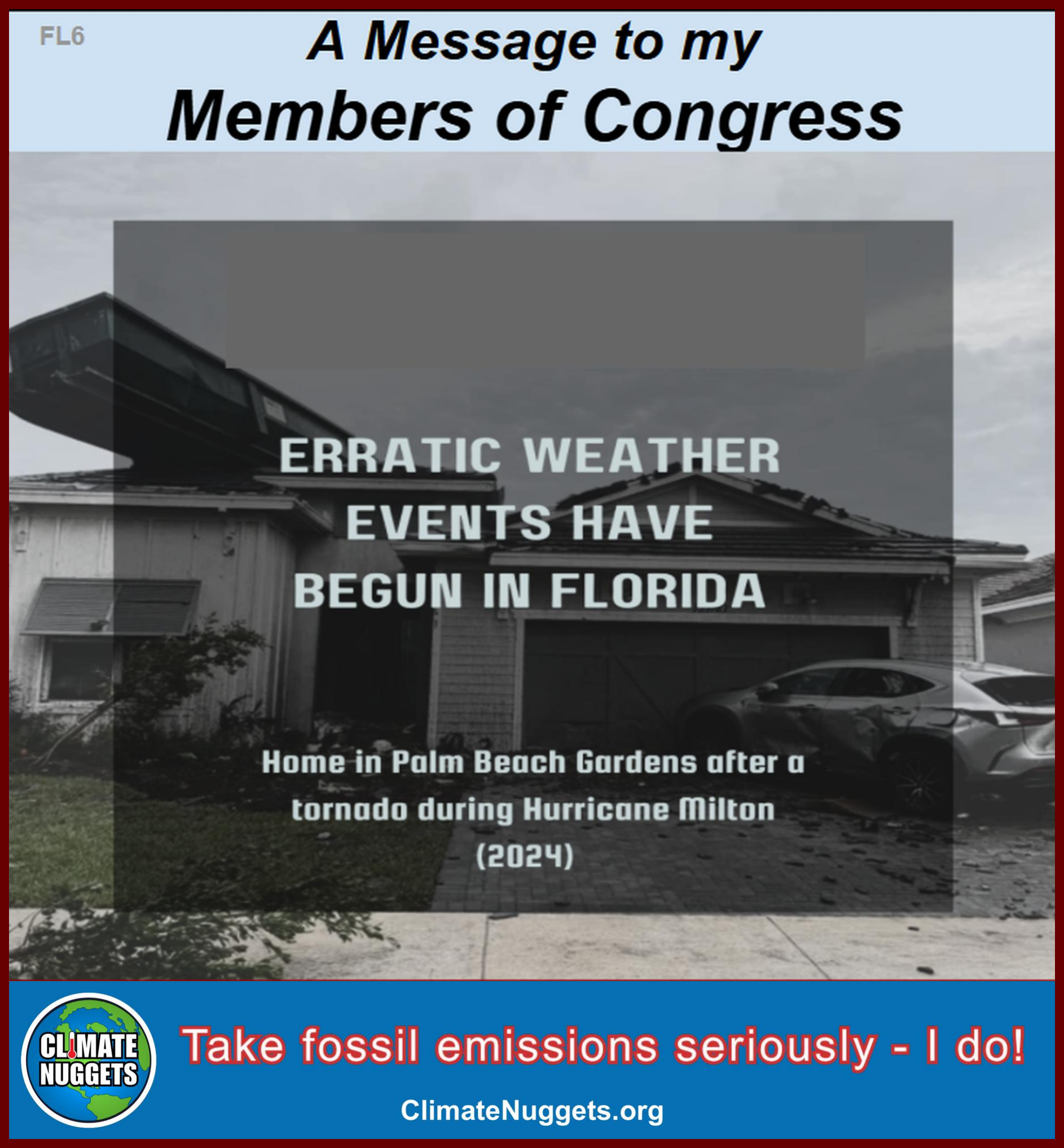
Erratic weather is only getting more intense from global heating. Focus on the problem - fossil fuel emissions.
Heading 5
Resource Materials specific to Florida
SCIENTIFICALLY-VALIDATED, FLORIDA-SPECIFIC CONCERNS
These CONCERNS are derived from materials prepared by the Florida Climate Center (FCC) at Florida State University (FSU). FCC serves as the primary resource in the state of Florida for climate data, information, and services. The Center was established to be the first stop for climate data and information for citizens, organizations, educational institutions and private businesses in the state of Florida.
The FCC’s discussion of the timing and possible impacts of Climate Change in Florida, the basis for our CONCERNS below, can be accessed at their discussion of Climate Change, where the FCC provides its own fine-tuned look at specific Florida situations. This material builds directly on the congressionally mandated, heavily peer-reviewed US Government report on climate change impacts, risks, and responses - the Fifth National Climate Assessment released in 2023. Particular sections of interest to Florida are: Fifth National Climate Assessment 2. Climate Trends and Fifth National Climate Assessment 22 . Southeast .
CONCERN 1: TEMPERATURE TRENDS The Florida Climate Center (FCC) documents large land and ocean temperature increases, already experienced from global warming, and they expect further increases in the immediate decades. The FCC attributes these changes to human emissions of greenhouse gasses.
-
Florida has seen a remarkable warming trend over the past decade, and July and August of 2023 each set a new all-time monthly temperature record for Florida (at 84.1°F and 84.9°F, respectively).
-
Warming ocean temperatures are expected to lead to more marine heatwaves, which in Florida can further contribute to extreme heat waves felt on land. Marine heatwaves can have devastating impacts to marine life like coral reefs.
-
Since the beginning of the 20th century we have already experienced land temperature increases of 3.5 F across Florida, contrasted to the global average increase of 2.7 F.
-
Our night-time minimum temperatures (required to recover from the hotter days) are also increasing.
-
As the average temperature rises, the likelihood of experiencing more frequent and intense extreme heat will also increase. The FCC projects that by 2050 Floridians may endure an average of 30 more days per year above 95 F - this ranges from 10-20 more days on the coasts to 20-40 more in the panhandle, to more than 40 around the inland peninsula.
CONCERN 2: PRECIPITATION TRENDS While Florida’s precipitation varies considerably from year to year and on a decadal basis, major global warming impacts are already being seen and more are expected.
-
Extreme precipitation events are expected to become more frequent and intense in a warmer world. Recent heavy rainfall events, such as the extreme rainfall event in Fort Lauderdale on April 12, 2023 and recent hurricanes (Idalia, Ian, Nicole), are consistent with expected increases in precipitation, tropical cyclone intensity, and coastal storm surge flooding in a warmer world with higher evaporation rates and atmospheric moisture.
-
Average annual precipitation is projected to increase in North Florida and decrease in South Florida, with higher confidence in changes for North Florida.
CONCERN 3: CLIMATE CHANGE AND HURRICANES Of particular importance to Florida and the Southeast is how climate change will influence tropical cyclone activity and associated hazards.
-
Coastal flooding from storm surge is expected to increase regardless of changes in storm intensity due to future sea level rise.
-
It is projected that flooding rain associated with hurricanes will become more hazardous, particularly in light of the notable trend of slower-moving storms that has recently emerged.
-
While the mean intensity of hurricanes has not changed significantly in the past, warmer oceans raise the ceiling for intensity. A larger proportion of storms have reached major hurricane (Category 3-5) strength in recent years, along with an increase in rapid intensification events.
-
The locations where hurricanes reach their peak intensity have shifted away from the equator poleward and toward the west, or closer to land in the Atlantic basin, with other regional changes in hurricane tracks observed.
CONCERN 4: SEA LEVEL RISE Florida is among the most exposed states in the country to sea level rise and coastal storms. With its low-lying coastal topography and more than 8,400 miles of shoreline, much of Florida and its coastal population are vulnerable to the impacts of rising sea levels. While vulnerability to sea level rise varies considerably across the state, with many inland areas at much higher elevations, sea level rise impacts will not be restricted to areas along the immediate coast.
-
Florida sea levels are now rising at rates up to more than 3 inches per decade and are increasing. Projections of sea level rise for the Southeast U.S. average 16 - 23 inches by 2050. By 2100, these estimates increase to 2.2 - 7.3 feet and up to 13 feet by 2150, relative to 2000.
-
Sea level rise will increase high tide flooding events and saltwater intrusion, which already impacts coastal forests and estuaries, contaminates drinking water supplies, exacerbates flooding impacts, and has led to more frequent harmful algal blooms in Florida. Higher sea levels can also lead to higher storm surge levels and greater coastal flooding during tropical cyclones.
-
Coastal communities across the state are already seeing the impacts from rising sea levels and are taking steps to address these impacts. In some places, sea level rise threatens to disrupt daily life, such as where increased street flooding with saltwater can impact people, infrastructure, and vehicles. As sea level rise continues and accelerates, greater adaptation actions will be needed to minimize impacts and prepare communities for increased flood risks.
CONCERN 5: DEMOGRAPHIC AND LAND USE TRENDS The impacts of a changing climate will also be driven by demographic and land use changes happening in the state and elsewhere. Florida has one of the fastest growing populations in the country and its population is expected to continue to rise.
-
Population growth, along with continued development, will expose more people, communities, and assets to extreme weather and climate, increasing the state’s overall risk to climate variability and extreme weather events. Increased exposure to extreme events like heat and flooding will result in short- and long-term impacts and lead to adverse public health outcomes, such as heat-related illness and mortality, especially among more vulnerable populations.
-
While the climate of Florida and the Southeast is already changing and will continue to change over the coming decades, the extent of change and severity of impacts will depend in part on human actions. Communities are preparing by becoming more efficient, reducing greenhouse gas emissions, identifying vulnerable sectors of society, scaling up adaptation strategies to mitigate risks, and planning with an eye toward the future.
Sample, Top-Level Questions from Constituents
-
Is climate change real? How strong is the evidence?
-
What causes it?
-
Is it a serious and urgent threat? What is your understanding of potential global impacts and the timing of those impacts, which form the basis of your policies for climate change?
-
What goals (with respect to causes, behaviors, and especially timing) are critical for human and planetary health and sustainability?
-
What policies are you committed to help achieve (reduction of emissions, transitions of behaviors and technologies, adaptation, resiliency, etc.)?
-
Is climate change of special concern for Florida? Why? What effects are we seeing? Which Floridians are most vulnerable?
-
o Sea level rise, flooding and extreme precipitation
-
o Increased hurricane threat (number and intensity)
-
o Extreme heat and humidity
-
o Spread of disease
-
o Water quality
-
o Tourism impacts
-
-
Can we afford to address climate change?
-
What are the opportunities created by addressing climate change? What are the adverse impacts, if any?
-
Are we as a country doing enough to address climate change? What should we be doing differently?
-
Economists overwhelmingly support putting a price on carbon as the fairest and most effective way to reduce carbon emissions. Are you familiar with carbon pricing policies? Would you support a carbon price to reduce carbon emissions?
-
How important is it to you to address climate change? Where does climate change fall in your priorities as a legislator?
-
Should Florida bear any responsibility globally to reduce greenhouse gasses it currently emits? If yes, what form should that take?
-
Do you support the administration’s actions on climate change? What would you do differently, if anything?
More In-Depth Questions, provided for context and background preparation only;
You have stated that Climate Change must be addressed. Specifically, on what timeframes do you expect significant changes, and, again specifically, what are the impacts you anticipate on those timeframes? Finally, to what causes do you attribute the current and projected changes to the climate? This foundation is critical to assess the relevance and utility of your proposed policies. [SEE #11 BELOW FOR AN ALTERNATE APPROACH]
-
With its low-lying coastal topography and more than 8,400 miles of shoreline, Florida is among the most exposed states in the country to sea level rise and coastal storms. What approach would you take as a Senator to address this Real Estate issue?
-
The Florida Climate Center at FSU expects the number of days of extreme heat to increase significantly in the next decades, particularly in the inner peninsula. Are there any Florida-specific initiatives which could help outdoor workers and others, such as athletes and children be safer?
-
More extreme precipitation events, such as seen recently in Ft. Lauderdale, are expected, as are general reductions in precipitation in South Florida and increase in average precipitation in North Florida. How would you help the state and communities prepare for such changes?
-
Businesses considering operations in Florida are surely aware that global changes, combined with state population growth and development, will expose more people, communities, and assets to extreme weather and climate and rising insurance rates, increasing the overall risk of investment. How will you respond to such concerns?
-
Tourism is, obviously, of highest importance to the economy of Florida. Thinking of our beaches (we are running out of affordable and sustainable sources of beach sand), parks, biodiversity, our fishing industry, and the other beauties of our state, what measures must be pursued to protect our natural attractions for this industry (and for our quality of life)?
-
Water quality as it impacts our lakes, the Everglades, and coastal estuaries is a major, long-term problem. Also, are water shortages of concern? What specifically can be implemented in the next 6 years?
-
Health risks, including dengue fever and heat stroke are already disproportionately hurting vulnerable populations and must be addressed. How can this be done?
-
Should Florida bear any responsibility globally to reduce greenhouse gasses it currently emits? If yes, what form should that take?
-
What do you plan to do to mitigate economic burdens from these unfolding realities within the next 6 years?
-
You have stated that Climate Change must be addressed. The best science available suggests that, if we continue on the current path of fossil fuel emissions, the average global warming of 1.5 0C (2.7 0F) is imminent; 2.0 0C (3.6 0F) could be reached around 2040; and 3.0 0C (5.4 0F) warming above pre-industrial levels could passed by around 2070.
The impacts on climates and societies with those levels of warming would be profound. Global migrations by 2040 - 2070 must be expected because of such factors as: Rising Temperatures and Intensified Precipitation; Species Extinctions and Migrations; Expanding regions risking Mortality for Humans; and Major shifts of the human temperature niche.
In addition to the migrations which could be forced over large populations, continuously disrupted living conditions can be expected, even in more stable areas. Increasingly Erratic and Intense Weather; Rising Sea Levels; Tipping Points; and Compounded Impacts of climate changes are already being experienced.
Essential to avoiding these devastating outcomes is radical reductions of global fossil fuel emissions. Cuts on the order of 50% by 2030 and 100% by 2050 are needed to keep warming under 2.0 0C (3.6 0F), and even then profound impacts would be likely.
Are these “best assessments” from the scientific community the foundation of your proposed policies with respect to Climate Change? Please clarify how your proposed policies are relevant and useful with respect to the scientific projections of our circumstances.
Resources used in Developing Questions
The following major peer-reviewed reports were used in developing questions for the candidates. Sections in red are the most directly linked, to assist the reader.
Intergovernmental Panel on Climate Change (IPCC) [United Nations]
IPCC Sixth Assessment Report —Synthesis Report
Summary for Policymakers IPCC_AR6_SYR_SPM.pdf
AR6 - SYR - Headline Statements
U.S. Global Change Research Program [U.S. Government]
National Climate Assessment 5 -NCA5-Full Report
(The above references are now not accessible because they were pulled by the current administration)
Fifth National Climate Assessment (Archived, but still available)
American Resiliency [non-profit dedicated to articulating the NCA findings]Florida 2050 Climate Forecast: 2023 Update